Building Experience
On March 11th, 2020, I was a little 7th grader who couldn't contain her excitement after hearing I would get 2 weeks off from school due to the global pandemic, COVID-19. I would have never realized the impact this event would have on my life. School, extracurriculars, recreation, and even my friendships would be moved online for over a year. During this time, all I could feel was an overwhelming sense of disconnect.
Throughout 2020-2022, I familiarized myself with the popular social platform Discord for school clubs and friend groups. During this time, I acted as a server moderator for a public server with over 1000 members. I also experimented with building servers: a few practice ones, and one for my school's Anime club. I familiarized myself with bot integrations, role hierarchies, and moderation commands. This would build the foundation I needed for the creation of Orbis Civitas.
The Birth of Orbis Civitas
As the world finally started to return to normal, I entered my freshman year of high school. I made friends that changed my life for the better; however, we wouldn't really speak to each other outside of school. I noticed a need for new ways to interact with each other. Thinking back to my past experiences, I thought that creating a Discord server could help keep us connected.
"Orbis civitas" can be translated from Latin to mean "world city", which could refer to a city-state or major city. To me, Orbis Civitas meant creating a space that my friends and I could always return to, no matter where we were in the world. Rather than a simple group chat, we could have something that could grow with us; something more organized, more customizable.
Growth
This is the typical starting point of a Discord server:
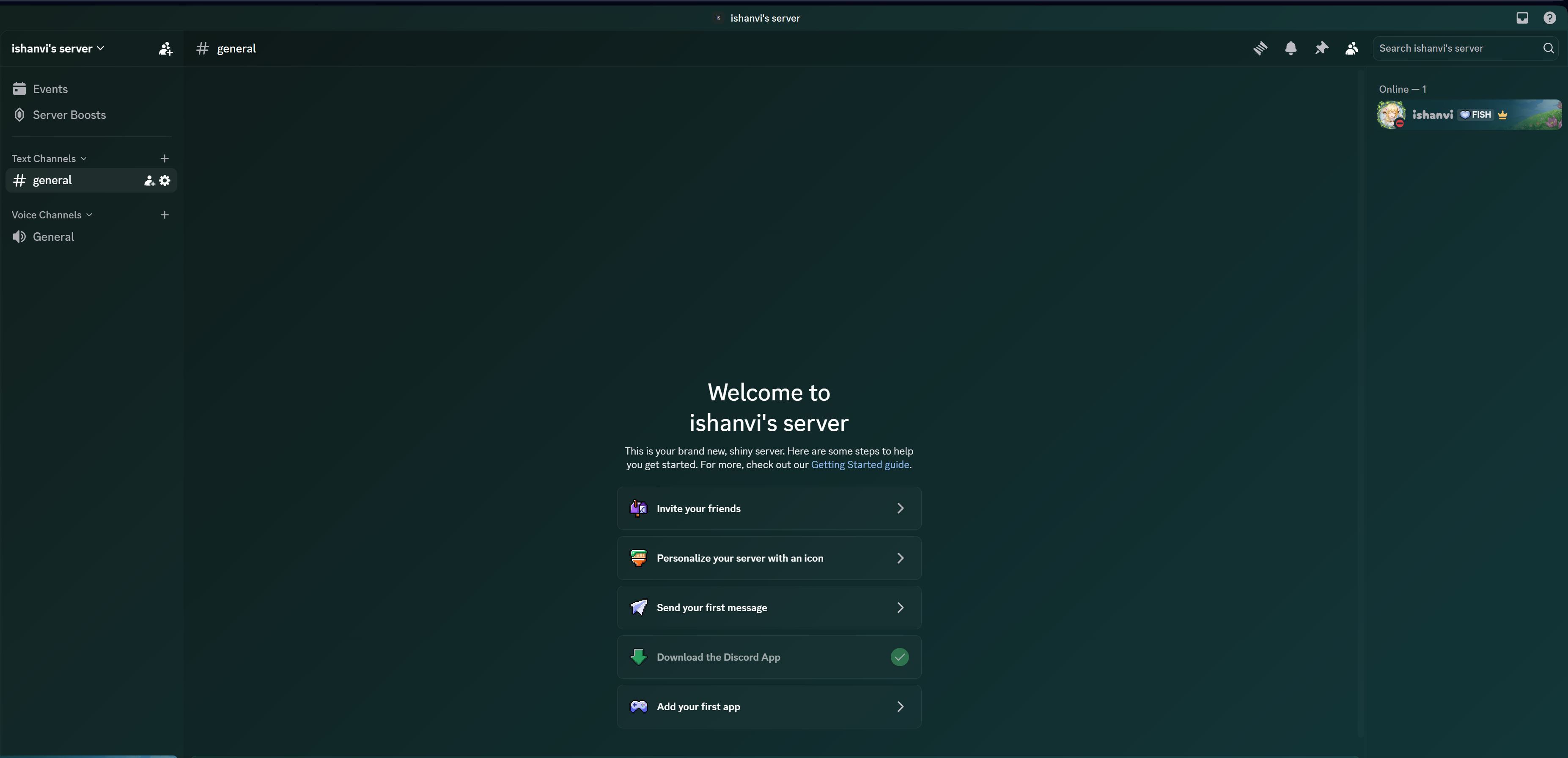
This is Orbis Civitas today:
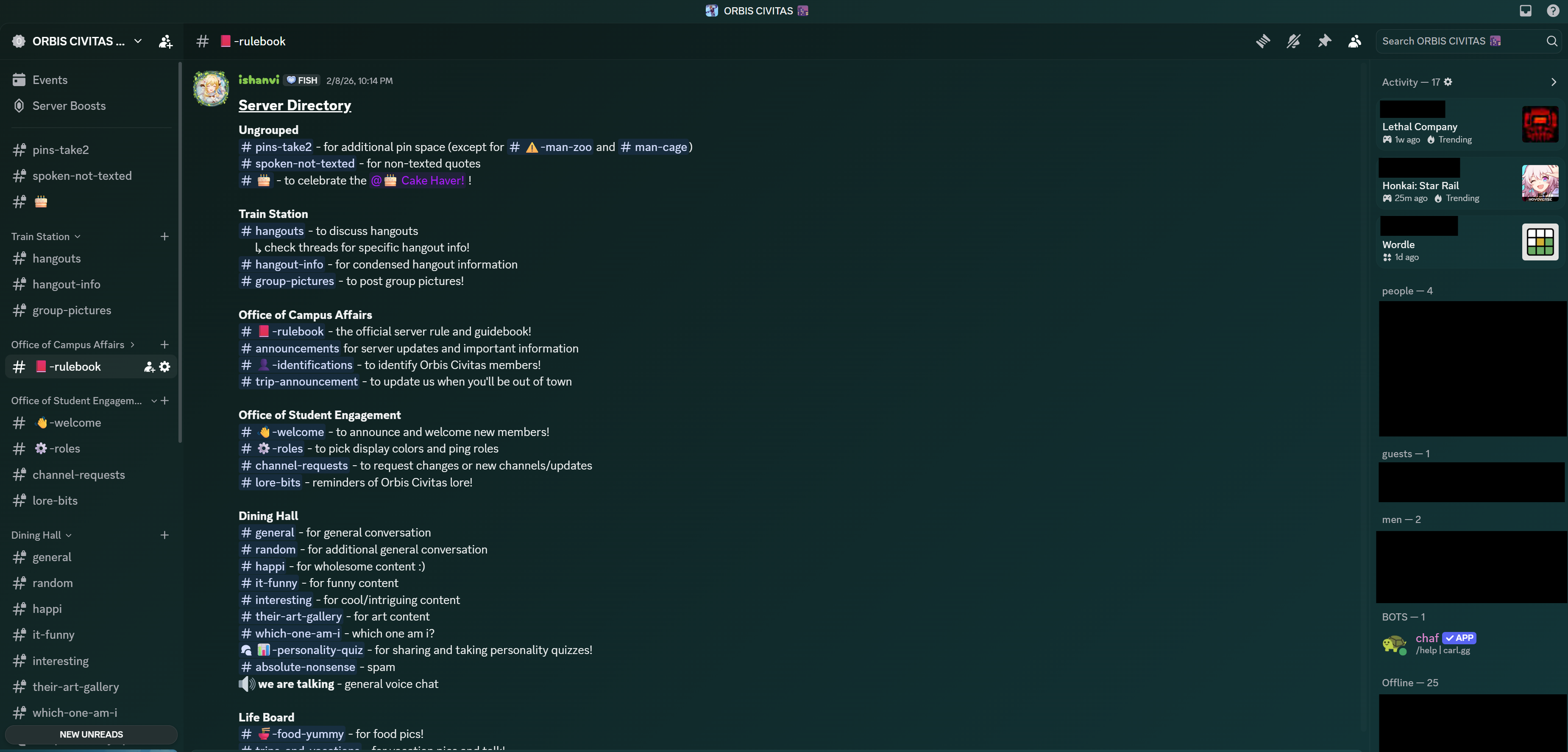 Orbis Civitas started with 5 people, and now has over 30 active members from our community!
Features
When designing Orbis Civitas, I modularly implemented many features.
Reaction Role Assignment is commonly implemented in Discord servers, usually for setting username colors or pronoun tags. It involves a bot integration, which will read in set reactions as a trigger event for role assignment. I implemented reaction role assignment in Orbis Civitas using the third-party bot Carl-bot. This would involve learning the Carl-bot interface, but would also give me access to tools like custom embeds, customizable assignment behaviors, and sticky roles.
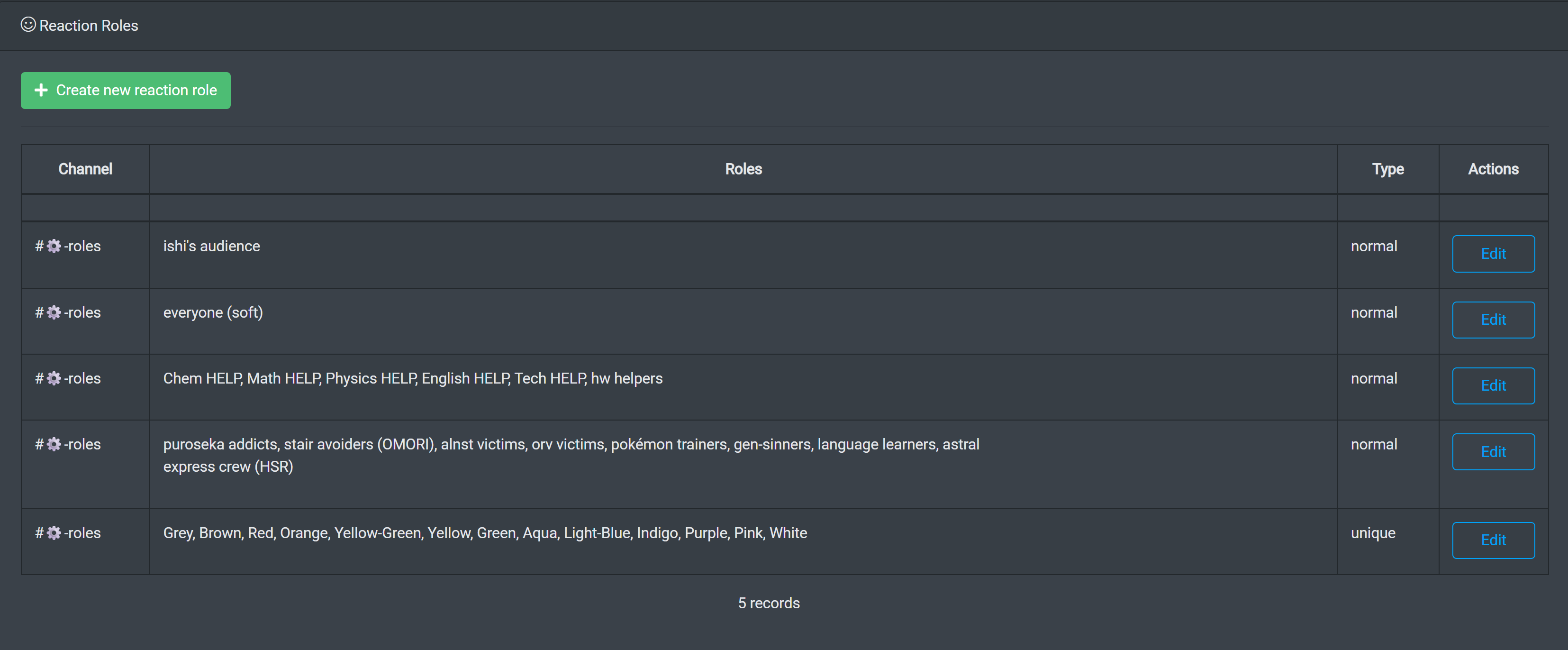
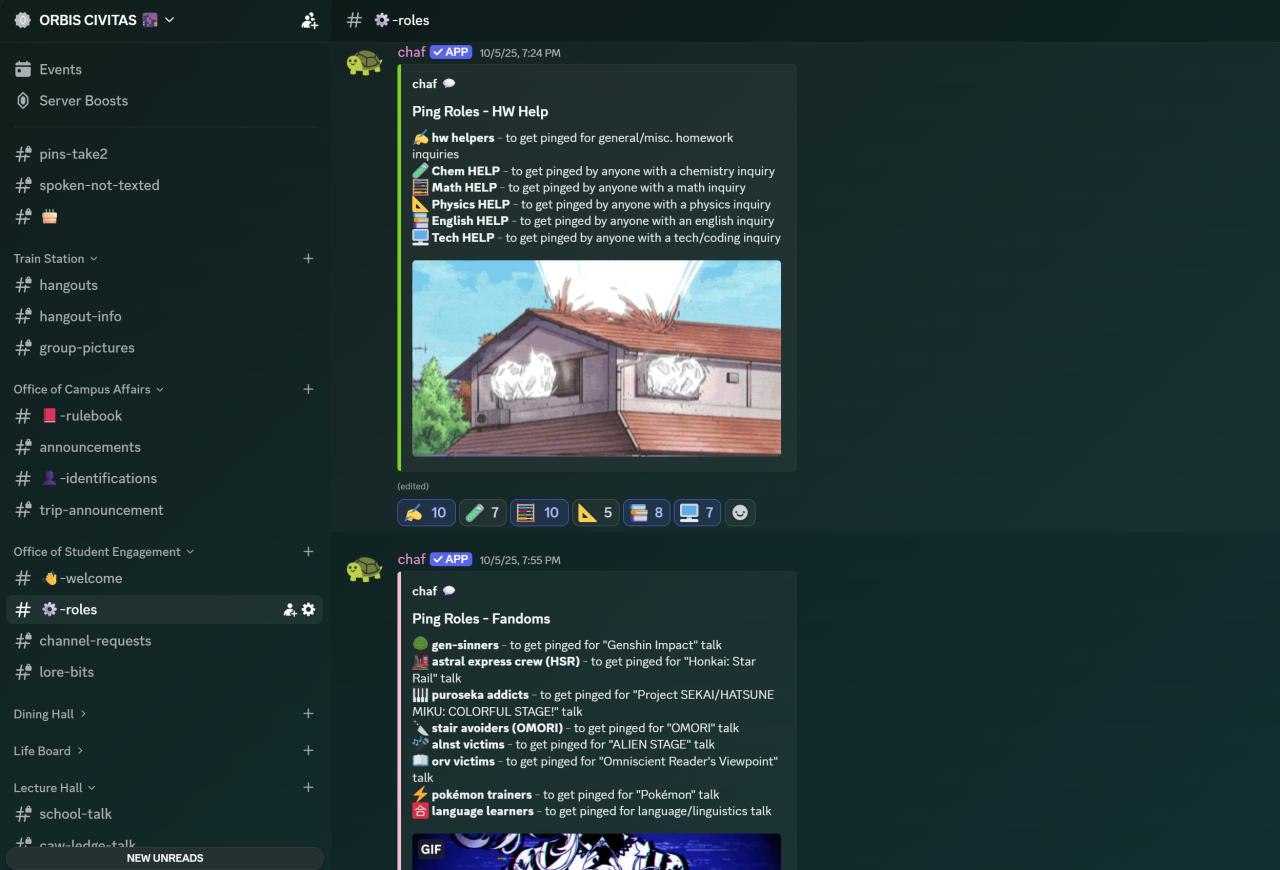
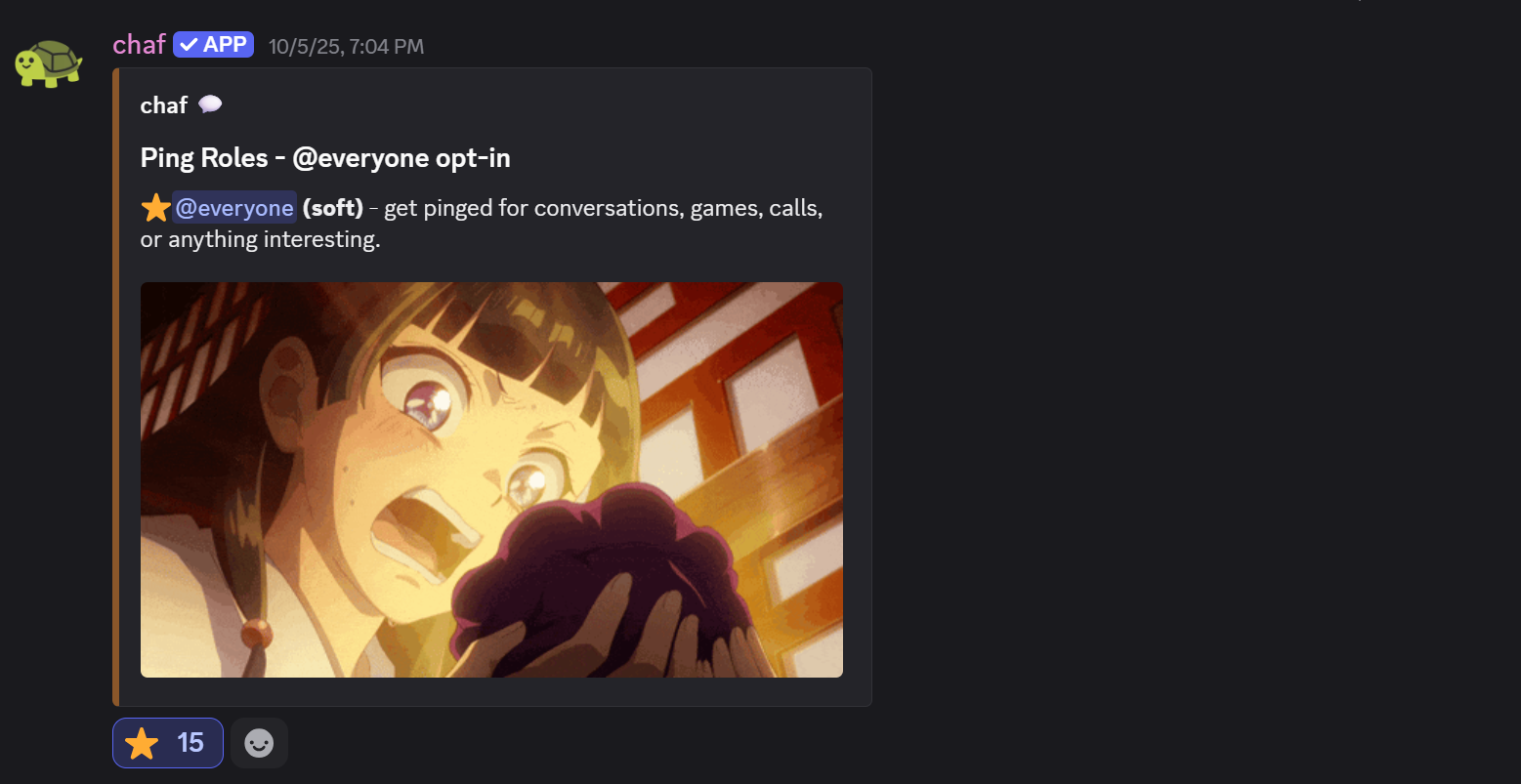
Using reaction roles, I implemented Ping Roles, which took advantage of the opt-in nature of reaction roles to create optional pings. This was implemented due to the unavoidable nature of Discord's @everyone, which caused members to mute the server and interact less. By creating specific roles, like tutor roles and hobby roles, each user can cater their notifications to their own interests.
I also indirectly overrided Discord's @everyone by creating an opt-in @everyone, which involved disabling @everyone for users and instead creating a reaction role to use in place of @everyone. This is useful for those who mute general notifications due to fast server activity, but are also okay being summoned for conversations, gaming, calls, etc.
To invite new members but also respect the privacy of older members, I implemented a role hierarchy that allows for a split server design with both shared and private channels implemented by roles.
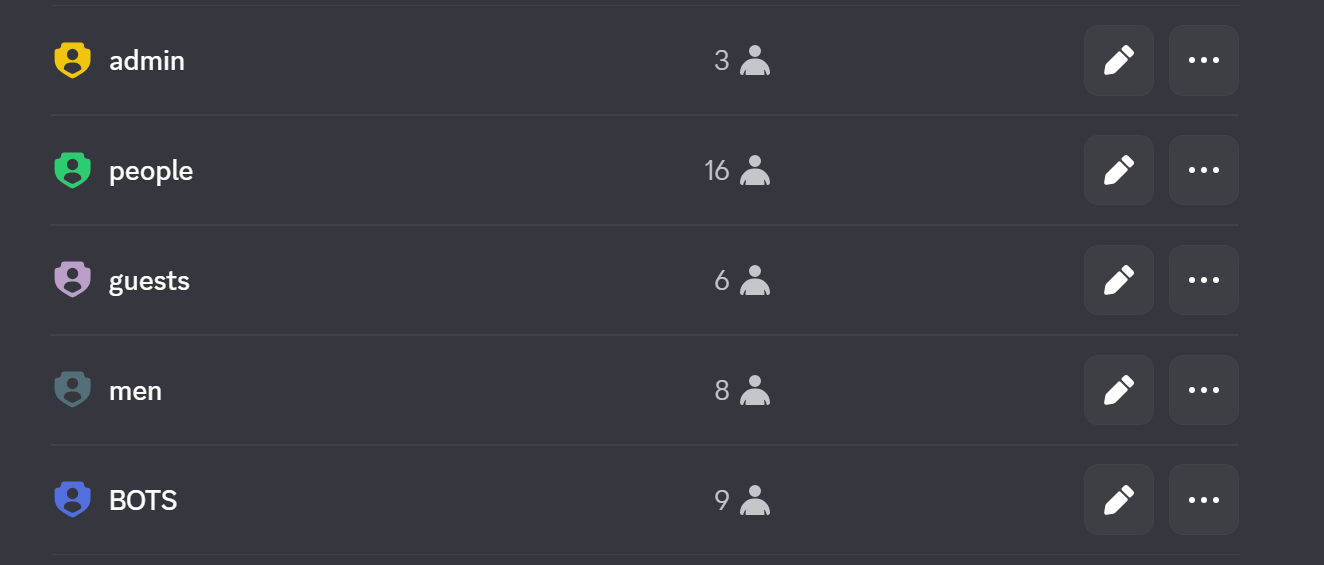 Initially, intended access broke due to setting channel permissions individually. By leaving most channel permissions neutral and setting default permissions through roles, I fixed the issue while simultaneously making it easier to keep track of permissions.
Due to Orbis Civitas' small scale, I implemented "rooms," or custom categories and channels specifc to each member. By taking advantage of role hierarchies, I made it so members could edit certain non-destructive parts of their own categories and channels.
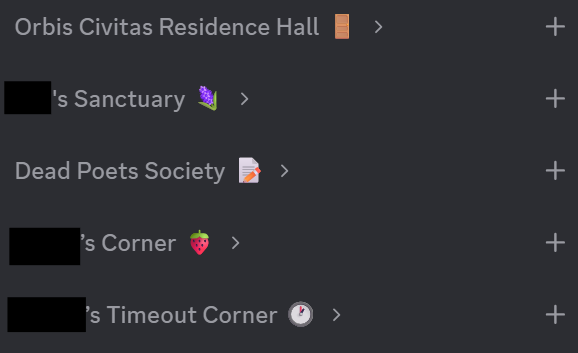
This is not a scalable feature, and should not be implemented without trust in users. This could possibly be a "ranked" feature in larger servers, which could involve leveling up (usually judged by server activity) to gain reputation and unlock custom spaces. However, this will contribute to channel bloat.
In fact, I experienced channel bloat due to having multiple custom categories. My solution was to combine categories with less than 3 channels into a single category called the "Residence Hall."
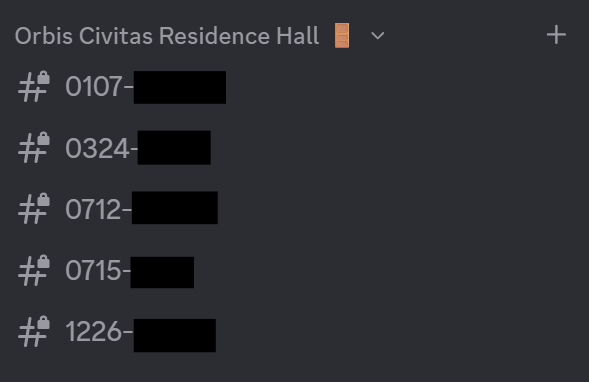
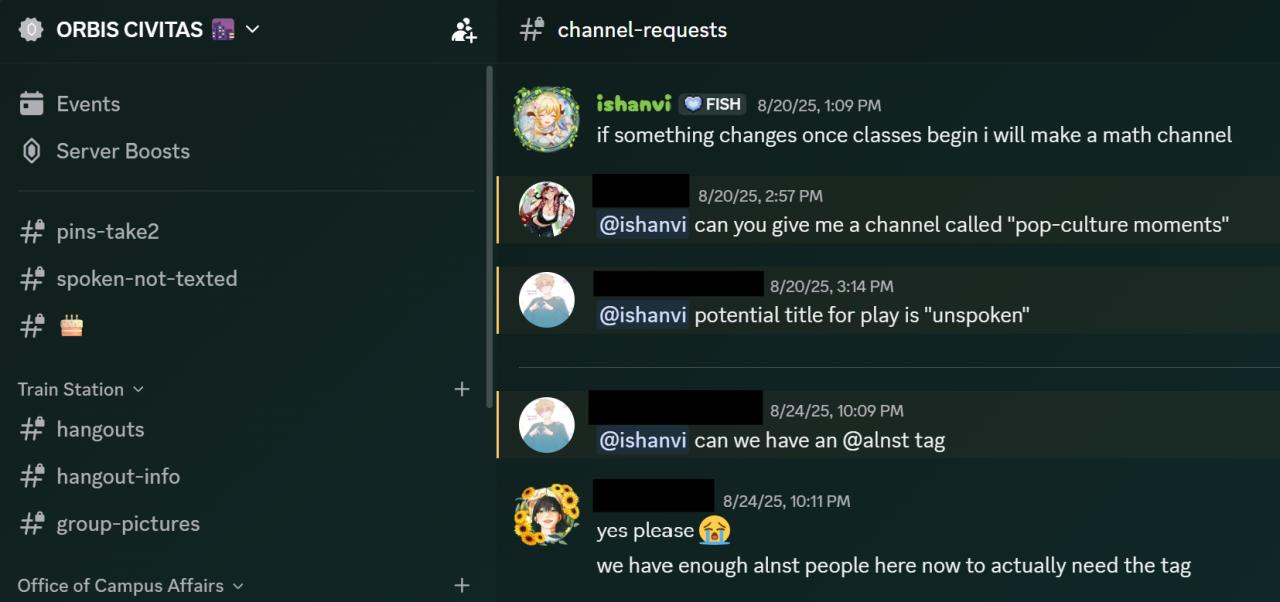
To note, I reduce channel bloat by regularly monitoring channel use for the whole server and also taking advantage of a feedback/request channel to discuss possible changes. The server undergoes regular purging of inactive channels. I have also reduced bloat in the past by implementing more role hierarchies to create opt-in channels.
To reduce channel bloat, I considered condensing categories into forum channels. A media forum channel could branch videos into specific threads (funny, educational, wholesome) while taking up the space of only one channel. I wanted to test the feature before making a change, so I created a separate duplicate channel that I kept available for 3 days so users could experience the possible structure change. After recieving negative feedback, I decided to not undergo the change.